God’s been good, giving me a beautiful place to live. I’m constantly learning about the stewardship it takes to care for this particular environment, which helps me appreciate how other places are cared for as well. Pastoral Song: a Farmer’s Journey (2021, Mariner Books) is well worth appreciating.
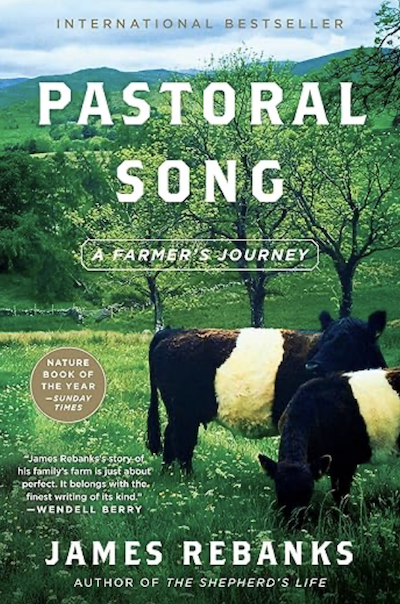
From its unsentimental early tone, the book becomes downright poetic as it develops. This nonfiction work is about author James Rebanks’s inheritance of a tradition of family farming. He reflects on the future, learning from the past. He writes of land and the challenge of stewarding it well.
The author grew up on a family farm in northern England, with parents who worked hard and set examples without providing explanations. The author built a closer bond with his grandfather, who farmed nearby land. His grandfather patiently taught him about things the parents had no time to explain, about cultivating the land and caring for the animals that were integral to farming.
In early adulthood, Rebanks spent time in Australia, and his description of that formative period is a small masterpiece. The contrast between Australia and home brought his parents’ farm into sharper focus for him. He found that he missed it in a way he hadn’t thought possible. He returned to England keenly interested in farming, running smack into changes that were to push his family’s farm into crisis.
Efficiency had become a watchword in his absence, bringing factory farming with it. “And in place of an old patchwork landscape full of working people, diverse farm animals, and crops, with lots of farmland wildlife, a blander, barer, simpler, denatured, and unpeopled landscape had emerged.” Crop rotation and diversity had given way to efficiencies that only made economic sense in the short term.
In the face of that shift, Rebanks retained a long-term view that took into account how soils and land would look a generation hence. He writes of his appreciation for the careful, exhausting work that goes into creating and maintaining things like hedges. Such hedges on farmland were among the casualties of “efficiency” until local farmers on small holdings decided to bring them back, which also brought back the birds and wildlife dependent on such plantings.
“…[P]rogress somehow never quite fully happened on my grandfather’s farm in the fells. We held on to that backward little farm and it became – for my father and for me – a counterpoint to the new farming. Unexpectedly, this odd combination of two different kinds of farming changed my family.” Rebanks discovered that long-term thinking affected family relationships as well as land.
Pastoral Song is a thought-provoking guide to a way of life that may be unfamiliar to a reader who relies on farming without realizing it. Without being dry or didactic, Rebanks hands on to the reader his appreciation for the land and the people who work on it, and he writes with an eye to the next generation. “Far from being anachronistic and obsolete, the world’s most ‘backward’ farmers are a vital resource pool for the future.”
This post is shared to the monthly Open Book linkup hosted at My Scribbler’s Heart and CatholicMom.com.
 Ellen Kolb