Finding Flannery: A Travel Memoir Exploring the Mystique of Flannery O’Connor and the Legacy She Has Left Us All (En Route Books and Media LLC, 2025) by Christina Brajkovich, Karen Anne Mahoney, and Roxane B. Salonen
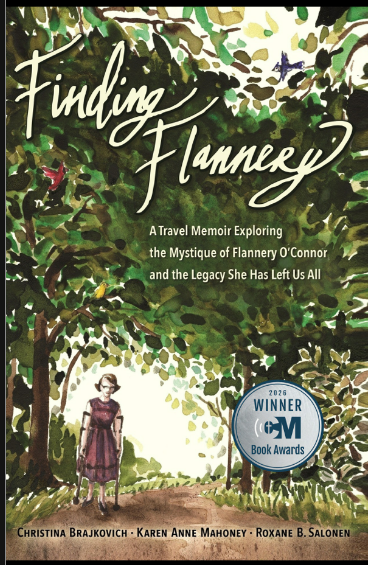
A book with three authors can be disjointed, but Finding Flannery flows smoothly from one chapter to the next. Within each chapter are sections with three first-person narratives, and I can’t help but salute the editor who wove voices together so deftly. Each writer – Christina Brajkovich, Karen Anne Mahoney, and Roxane B. Salonen – adds a different dimension to what is more than a travel memoir.
One needn’t be a fan of the often-difficult fiction of Flannery O’Connor (1925-1964) to appreciate this book. If anything, as the authors go to Georgia to discover O’Connor’s milieu, they illuminate her gifts and Catholic faith in a way to inspire discovery, or re-discovery, of her work.
While the three women may have begun their journey intending to explore what they call the O’Connor “mystique,” their account of traveling to Georgia is rich in itself. The American South was unfamiliar territory for three Catholic writers coming from the north. They eased into it as they drove, enjoying hospitality from a fellow writer before making brief pilgrimages to the renowned Abbey of Gethsemane (where Thomas Merton found his spiritual home as Fr. Louis) and the motherhouse of the Sisters of Loretto, both in Kentucky.
Their ultimate destination was Andalusia, the farm where O’Connor lived in Milledgeville, Georgia. O’Connor wrote piercing fiction (“…the oddities of our world with a heavy side of grace”) and perceptive essays while maintaining a lively flow of letters with many correspondents. Eventually, she developed lupus, a disease which gradually limited her mobility and strength. Her disciplined habits, which included daily Mass, sustained her as she kept writing to the end of her life.
Finding Flannery is filled with curiosity and humble openness to the unfamiliar, with observations and reflections about O’Connor’s work and legacy conveyed with clarity and appreciation. The three authors don’t shy away from problematic aspects of O’Connor’s life and work. They recognize Andalusia’s flawed human being, a woman who shared their faith in God despite differences in time, place, and experience.
The book would have been incomplete without the travelers’ accounts of their own lives and faith journeys, offering insight into what drew them to Andalusia in the first place.
Every page of Finding Flannery is informed by humble faith, gratitude for good fellowship, and deep respect for the craft of writing. Authors Brajkovich, Mahoney, and Salonen have left me open to approaching O’Connor’s fiction once again, this time with a better understanding of the woman who wrote it and the place from which it came.
This post is shared to the Open Book blog linkup, found monthly at Carolyn Astfalk’s My Scribbler’s Heart and at catholicmom.com.

