Years of covering the work of pregnancy resource centers in New Hampshire have left me sure of a few things: each center is highly responsive to the needs of women in its specific region, each is committed to providing life-affirming alternatives to abortion at no cost to clients, and each is led and staffed by people who have no interest in getting involved in politics.
Sometimes, politics comes knocking on the door anyway.
That’s what’s happening a few miles away in Massachusetts. I took my first post-Covid trip to Boston the other day to learn more. The Massachusetts State House was the setting for a program highlighting PRCs and countering a pro-abortion taxpayer-funded “public education campaign” to undermine them.
If such a campaign is happening there, it can happen a few miles away in New Hampshire. I doubt that any state is immune from having its budget weaponized against pro-life services.
A million taxpayer dollars
A June 10 press conference headlined by Massachusetts government leaders launched the campaign to urge women to “avoid anti-abortion centers.” From the event’s press release: “This public education campaign, which will appear on social media platforms, billboards, radio, and transit, was funded through a $1 million investment that the Massachusetts legislature passed as part of its FY2023 supplemental budget.”
A million bucks could provide care for a lot of pregnant women. Prenatal care, housing, child care, transportation, clothing, furniture, even diapers: imagine what any nonprofit organization could do with a million dollars allocated to those needs. The state of Massachusetts is afraid that somebody somewhere might have those needs met by a group of people opposed to the direct intentional taking of human life.
PRCs aren’t political entities, but they’re run by people savvy enough to know a threat when they see one. Meet the Pregnancy Care Alliance of Massachusetts (PCALL), an affiliate of Massachusetts Citizens for Life (MCFL).
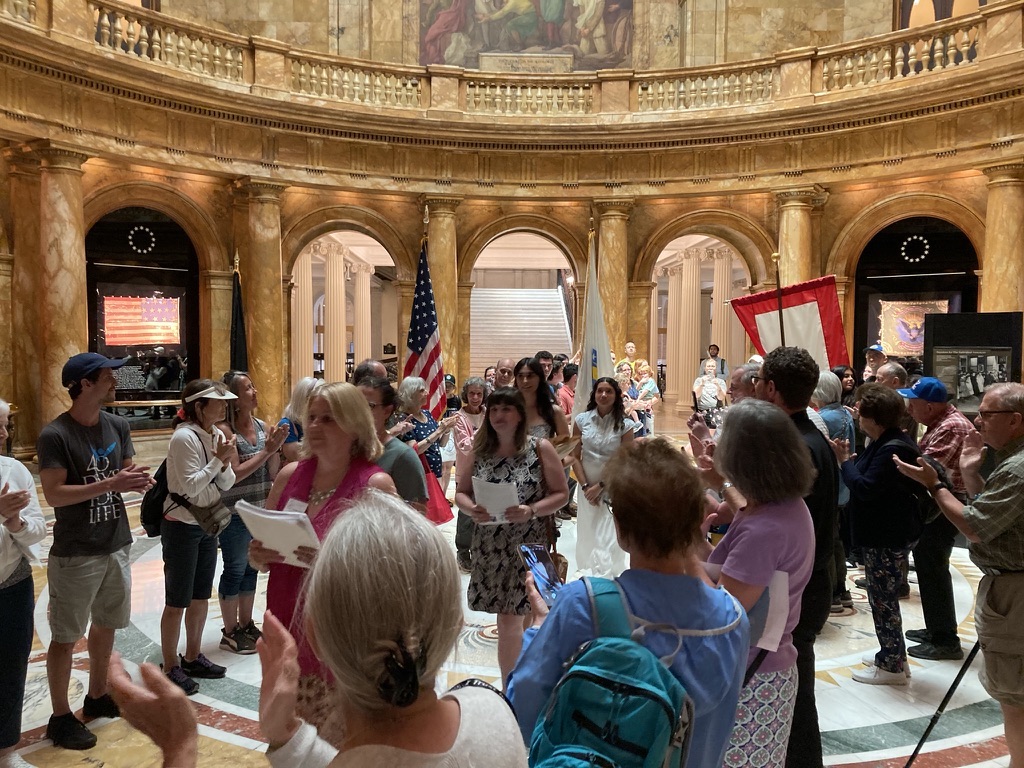
PCALL’s pushback on the state’s campaign was highlighted by Celebrate Life Day, held on June 25 in the State House itself. I was there to listen and take notes (which unfortunately didn’t include any guide to the spelling of speakers’ names). Here’s a bit of what I learned. Photos in this post are my own.
To the State House to celebrate life
I arrived at the Massachusetts State House that day to find a line from the front door extending almost all the way to Beacon Street, waiting for the security screening that’s unfamiliar to visitors to New Hampshire’s seat of government. Young adults dressed in suits mingled with people like me clad more casually in keeping with the summery weather. Were we all there for the same reason?
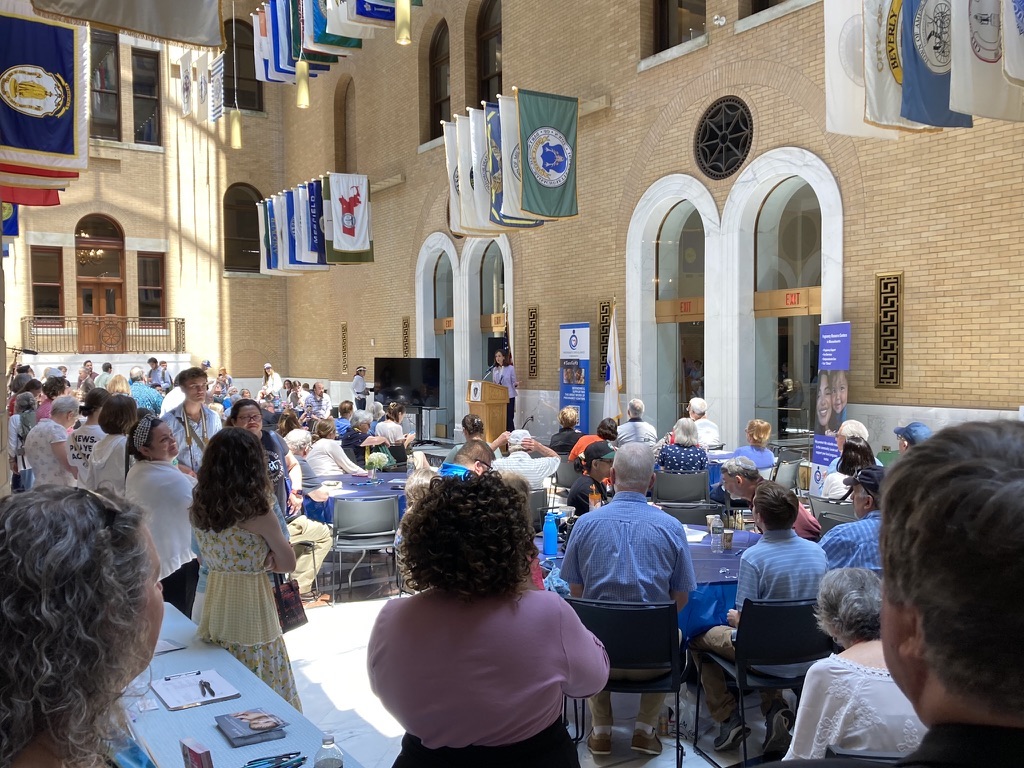
Not all, perhaps, but certainly most of us were there for the pro-life event, which was held in the capitol’s impressive Great Hall. It got started a bit later than expected thanks to the number of people who needed to go through security. The tables that had been set in the Hall, each with ten places, were quickly filled, leaving standing room only. Even the event’s organizers were surprised by the turnout.
I saw a lot of people with the wide-eyed look of citizens getting their first look at the inside of the State House. I was pleased. All pro-lifers should feel at home in their own state’s capitol – more at home than the politicians, actually. An elected official’s job is in theory temporary, while citizenship endures.
Early arrivals had time to browse the information tables lining the Great Hall and to speak with PRC representatives. I met Alicia, who directs two offices of a three-location PRC in Massachusetts’s Merrimack Valley. I remarked on the number of young people entering the hall, and she told me she wasn’t surprised. “Our younger people come in and want to volunteer, and I wonder ‘hmm…they have no experience.’ But they want to learn.”
Merrimack Valley, Metro West, Greater Boston, the Cape: PRC staff and volunteers were present from all these places and more. One of the attendees with whom I chatted was from Springfield, an hour and a half away. Commitment to PRCs was evident – as was concern over the state’s anti-life campaign.
“The one thing we don’t do: abortion”
After an introduction by Myrna Maloney Flynn of MCFL, PCALL co-chair Teresa Larkin gave a brief history of the Alliance. Solidarity among Massachusetts PRCs was reinforced In the post-Dobbs atmosphere in which PRCs were vandalized and threatened. She reviewed the services provided by various PRCs at no cost to the client, ranging from pregnancy testing and options counseling to ongoing support for pregnant and parenting women. She said that the state’s current million-dollar smear campaign “is about the one thing we don’t do: abortion.” The state’s campaign is designed to intimidate service providers and will put clients at risk of losing services. “It’s time to truly unite. Fight back, graciously and kindly.”
Some of the women served by Massachusetts PRCs spoke about their experiences with the agencies. Valentine talked about being pregnant, uninsured, and dealing with other health issues when she came across a web page for the Boston Center for Pregnancy Choices. She found the support she was looking for, during and after her pregnancy, with direct services and referrals for her and her child. “Even a baby shower,” she smiled. “This is the work of God.”
Charlene described how she came to a local PRC fourteen years ago at the age of 17, pregnant and dealing with her own childhood trauma. Influenced by the ongoing experience with the staff and volunteers who supported her when she was most vulnerable, Charlene today is doing what she can to pay it forward to other women in challenging circumstances.
Darlene of Abundant Hope in Attleboro spoke about abortion pill reversal, in which a woman who changes her mind shortly after taking the first dose of an abortion-inducing drug can receive medically-administered progesterone in an attempt to maintain her pregnancy. While abortion advocates have derided APR and questioned its safety, Darlene said that more than 5000 pregnancies have been brought to term using APR. Crystal, an Abundant Hope client, told the crowd that she had taken advantage of APR – and her child was with her, delighting the crowd.
MCFL’s Flynn had this to say about APR: if the media calls it “junk science,” people like Crystal and her son put the lie to that. “It is safe, and it is another choice.”
Another PRC director spoke of post-abortion healing. She introduced a member of her staff, once a client, now involved in her center’s post-abortion ministry.
A few staffers for legislators were in the room to hear these testimonies. Notably absent were legislators themselves, never mind anyone representing the Governor.
I’d like for every abortion-friendly legislator who has ever said “trust women” to listen to the women who spoke to me that day in Boston.
The petition campaign
According to PCALL, its members collectively provided more than $1.3 million worth of services in 2022, including pregnancy tests, ultrasounds, and material assistance to pregnant and parenting women. As one realizes after listening to the Celebrate Life Day speakers, the services offered by PRCs extend beyond those items. All services are free to clients, thanks to the support PRCs receive from donors.
No wonder a threat to those services sparked a petition circulated by MCFL and PCALL, with this appeal at its core: “We call on Governor Healey, Attorney General Andrea Campbell, each state senator and representative, as well as Robbie Goldstein, MD, PhD, Commissioner, Massachusetts Department of Public Health, to withdraw all attempts to thwart the work of our PRCs. We respectfully ask that these leaders issue a public acknowledgment that PRCs offer the choice women deserve.”
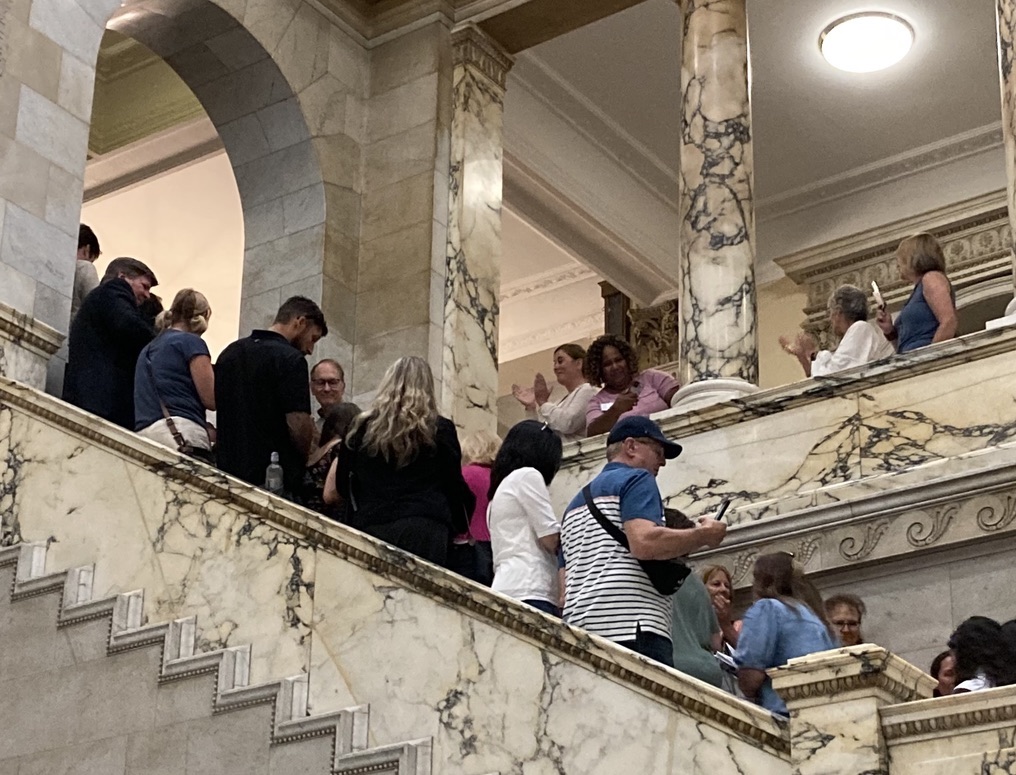
The last event within Celebrate Life Day was the presentation of 4000 signed petitions to the Governor, or rather to her office. The PRC clients who had spoken earlier in the day had the honor of carrying the stacks of petitions, walking between cheering supporters who lined the halls and stairways linking the Great Hall and the chief executive’s office.
That’s when I saw people who had nothing to do with the morning’s event stop and take notice as they went about their State House business. I heard “what’s this for?” repeatedly. Asking the Governor to support pregnancy care centers, came the answer. That got some startled looks.
Maybe being startled is what people need in order to be moved to constructive action.
Will the Governor back off? Not likely, although I’m open to being surprised. Individual women who are PRC clients and former clients can tell their stories publicly just as they did on Celebrate Life Day. Further, while public events have their place, one-on-one conversations with policymakers could change a few hearts.
That’s what we need to be prepared for in New Hampshire, individually and collectively. Watch diligently for anti-PRC legislation and state budget provisions next year. Until then, conversations between lawmakers and women who freely choose to share their PRC experiences could head off mischief like the Massachusetts million-dollar campaign.
As for ordinary people like me, we can continue to support our local pregnancy resource centers, and tell our elected officials why we do so. We could even invite them to join us.
Massachusetts Citizens for Life has produced a short video on Celebrate Life Day, available on YouTube.