Open Book: on silence, a border, and Granite State history

I stepped aside this year from professional public policy work at the state level. Dear to me as that vocation was (and is), it was time to take a break from the noise. During this time of transition I happened upon Robert Cardinal Sarah’s book The Power of Silence: Against the Dictatorship of Noise (Ignatius Press). The Guinean prelate’s name was familiar to me from news coverage and some of his social media work, but I had not known of the book before coming across a review of it.

Cardinal Sarah argues for silence as something to be cultivated as an indispensable condition for encounters with the sacred. The book is in the form of a conversation between the Cardinal and journalist Nicolas Diat. Each paragraph can be the inspiration for a period of contemplation. I’m finding it timely and challenging in the best ways.
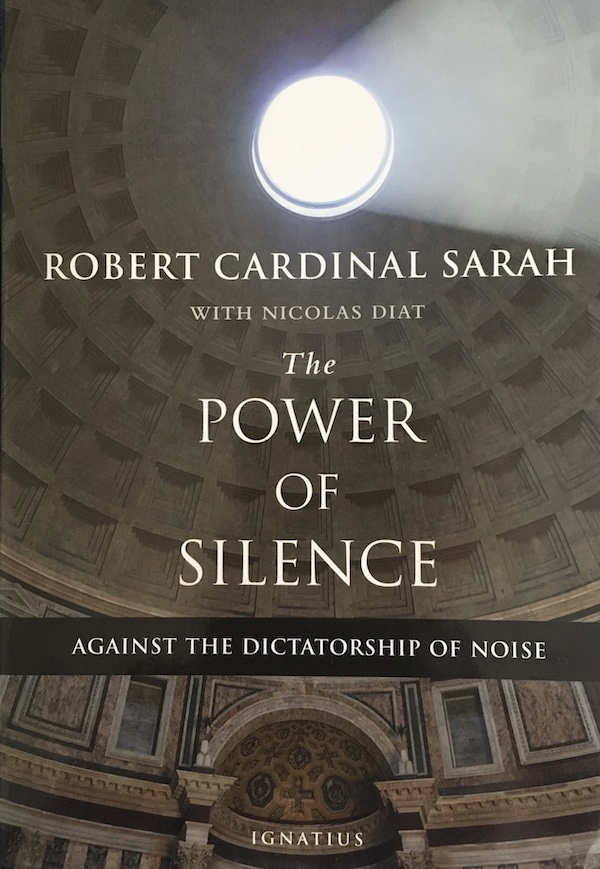
Cover photo from book "The Power of Silence by Sarah and Diat; design by Roxanne Mei Lum
Cover image by Roxanne Mei Lum

Another book found via a review (h/t Wall Street Journal for this one): The Border by Erika Fatland (Simon and Schuster). I’m only one chapter in, and I’m hooked. The subtitle sums it up: “A Journey Around Russia Through North Korea, China, Mongolia, Kazakhstan, Azerbaijan, Georgia, Ukraine, Belarus, Lithuania, Poland, Latvia, Estonia, Finland, Norway, and the Northeast Passage.” There’s history, of course. There’s a travelogue of sorts, but that’s not how to classify this book. The author’s encounters with people are at the heart of her work. I’m eager to follow her on the rest of her journey.

I rescued Upon This Granite from a neglected shelf recently. It’s a history of the Diocese of Manchester (New Hampshire), my home diocese, published in 1998 (Peter E. Randall Publisher, Portsmouth NH). It was a labor of love by a diocesan priest, Rev. Msgr. Wilfred Paradis, and it’s as close to an “official” history as can be found. It’s no tell-all. I’m finding it a good guide to the history of various parishes, particularly the ones founded by and for Catholics of specific ethnic or language groups. I like thinking how those communities have changed over the years, adding to our little state’s cultural texture.

Open Book: a suffragist, an astronaut, and an Adoration companion

Timely reading, entirely coincidental: a few days before the U.S. Capitol became the scene of violence and death, I began reading Jailed for Freedom: the Story of the Militant American Suffragist Movement by Doris Stevens. Written a century ago, it’s almost painfully relevant now. Stevens was one of the “Silent Sentinels” who stood in ongoing vigil outside of Woodrow Wilson’s White House, urging him to get behind women’s voting rights.

Not only did the President refuse for far too long, but he stood by when the women who were demonstrating were abused, arrested, and jailed. Note well that the violence was on them, not by them. These were not passive women; they were living proof of how tough nonviolence needs to be in its goals, persistence, and commitment.

That’s not an academic point. Witness the recent events in Washington.

Spoiler alert: President Wilson finally got the message, and so did Congress. The Nineteenth Amendment to the U.S. Constitution was ratified in 1920.

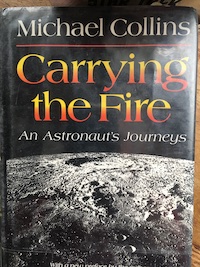
book cover Carrying the Fire by Michael Collins

A friend told me about Carrying the Fire, and I have no idea how I missed it before now. It’s wonderful. The author is Michael Collins, a man of parts, probably best known for his time as an astronaut. This memoir covers flight training, Air Force service, and his time at NASA including his role as command module pilot for Apollo 11. Collins writes like a dream; I read pages out loud just to revel in his style.

He offers unsparing (though not unkind) brief character sketches of his fellow astronauts. It’s interesting to read contemporary accounts of men who are now part of history.

Pioneering pilot Charles Lindbergh provides two fitting grace notes to the book. The first is his foreword. The second, shared by Collins at the end of the book, is a letter he wrote to Collins after the Apollo 11 flight. In the years since 1969, Collins has sometimes been treated as a footnote to the moon landing; he was the guy who had to stay in the ship while Armstrong and Aldrin left footprints on the moon. Lindbergh took a different view. The man who flew solo across the Atlantic understood the particular beauty and peace of solitude in purposeful flight. In his letter, he greeted Collins as a man who could understand that.

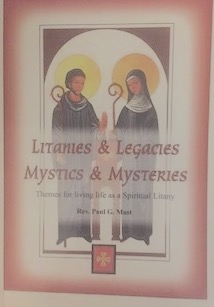
book cover Litanies and Legacies, Mystics and Mysteries by Rev. Paul G. Mast

Litanies and Legacies, Mystics and Mysteries: Themes for living life as a Spiritual Litany is a source of refreshment for me these days. It’s a good companion to Adoration. These are not the usual litanies. From author Rev. Paul G. Mast: “Each litany is different in biographical details and reflection material. But, all the litanies are pathways to God.” (GospelSoft Books, gospelsoftretreats.org)

Open Book is a monthly blog linkup hosted by My Scribbler’s Heart and CatholicMom.com.

Featured photo: Pixabay.

COVID-19 vaccine progress

Last April, the U.S. Conference of Catholic Bishops organized a petition drive to urge the federal Food and Drug Administration to make sure any COVID-19 vaccine be derived from ethical sources, not involving cell lines originating from fetuses killed by induced abortion. So what has happened since?

Some vaccines are in the testing stage already. Two, from pharmaceutical companies Pfizer and Moderna, have been much in the news over the past couple of weeks. In a recent EWTN interview, ethicist Joseph Meaney of the National Catholic Bioethics Center said that neither of those vaccines are developed or produced from human fetal cell lines. I’m happy to hear that, since those two vaccines will likely be the first to market.

As the bishops wrote in their petition last spring, “It is critically important that Americans have access to a vaccine that is produced ethically: no American should be forced to choose between being vaccinated against this potentially deadly virus and violating his or her conscience.

No matter who’s in the White House or Congress or the FDA or a pharmaceutical company’s board, that’s a message that is going to need to be delivered over and over again.

Photo by Artem Podrez, Pexels.com