The Mandate Takes a Hit. That’s Not Enough.

Nine months after taking office, five months after assuring the Little Sisters of the Poor that they could quit fearing fines, the Administration of President Donald Trump has announced a rollback of the HHS contraceptive mandate.

I’m pleased that the President has followed through on a commitment he could have carried out his first day in office. But I’m not going to grovel for recognition of my rights of conscience and religious liberty that should never have been abrogated in the first place. It’s not as though the President is doing me a favor.

Actually, today’s action does sound like someone thinks there are favors to be dispensed. The news coverage of the announcement speaks of exemptions, protection, and rollback. No mention of the First Amendment. It’s the First Amendment that’s at issue, which is something the mandate’s supporters have ferociously denied since 2012.

Why does the mandate stand at all? Why is there still anything from which to be exempted?

The contraceptive mandate came out of Obamacare’s definition of birth control for women as “preventive care.” In a manner beyond anything the rankest sexist could have dreamed, Obamacare made it government policy that the normal functioning of a woman’s body was something to be “prevented.” Contraception was shifted from being a matter of choice to being a matter of public policy, forcing employers who chose to offer health insurance coverage to be involved in employees’ birth control decisions. Nothing ever put employers into employees’ bedrooms quite like the contraceptive mandate.

It’s to the everlasting credit of the American Catholic bishops that they recognized the mandate’s threat to religious liberty. Among other things, they knew that the Catholic health care system – which provides care to more women than any other provider in the nation – could be fined out of existence by the mandate.

The mandate originally came with exemptions for some politically-favored companies and organizations. Hobby Lobby and other plaintiffs later earned a Supreme Court victory that was extremely narrow, releasing closely-held companies from the mandate. President Trump told the Little Sisters of the Poor earlier this year that they could consider themselves free from fear of being fined for not wishing to pay for insurance coverage for employees’ birth control. At least fifty other lawsuits are pending against the mandate; I don’t know how many just became moot.

Today, the mandate took a serious hit. It’s still staggering around, though. The only way to kill it is to abandon the policy that gave rise to it in the first place. Stop treating the suppression of women’s fertility as “preventive care.” Stop expecting “free” contraception. When “free” means compelling financial support from people with religious objections to contraception, then “free” is too expensive.

Today’s action from the Trump Administration is long overdue. It’s the biggest hit on the mandate since Hobby Lobby. The mandate’s foundation remains in place, though. For religious resisters to the mandate, First Amendment rights are still at risk. May today be a spark to renewed assertion of those rights.

Adapted from a post at Leaven for the Loaf.

Open Book: “Confessions of a Twentieth-Century Pilgrim”

For this month’s Open Book link-up, I offer Confessions of a Twentieth-Century Pilgrim by Malcolm Muggeridge (Harper & Row, 1988). I’m reaching back to my own bookshelf to pick up this short treat for the first time in many years.

It’s not a full-dress autobiography (see Chronicles of Wasted Time for that). Instead, Confessions is a brief survey of the phases in journalist Malcolm Muggeridge’s life, each a stage on what he recognizes as his pilgrimage. He was late in life, 79 years of age, when he was received into the Catholic Church. In Confessions, he looks back at the uneven route he took to get there.

I have always felt myself to be a stranger here on earth, aware that our home is elsewhere. Now, nearing the end of my pilgrimage, I have found a resting place in the Catholic Church from where I can see the Heavenly Gates built into Jerusalem’s Wall more clearly than from anywhere else, albeit if only through a glass darkly.

Each phase of life gets a chapter – The Boy, The Journalist, The Soldier, and so on, sketched with a lifelong journalist’s deft touch. I knew before I picked up the book how it was going to end; Muggeridge was a celebrity whose conversion made news. The heart of Confessions lies in the way he describes what led to that conversion: the steps and missteps and unlikely occurrences in his life.

He gives credit to Mother Teresa, whom he met in the course of a documentary project that remains his best-known work, at least in the United States (Something Beautiful for God). She gave a nudge, and left the rest to time and God’s grace. In her, Muggeridge’s lifelong skepticism met its match.

The younger Muggeridge would have been astounded to know where that would lead: “It was the Catholic Church’s firm stand against contraception and abortion which finally made me decide to become Catholic.” That was a countercultural claim, even thirty-odd years ago, particularly from a worldly man.

Despite such blunt declarations, Confessions is full of warmth and humor. I love his insight into what he calls “The Steeple and The Gargoyle.” Since reading this for the first time, I’ve never looked at a photo of an old church in the quite the way I did before.

This assumption that a sense of humour and a Christian faith are incompatible is totally mistaken….

The true function of humour is to express in terms of the grotesque the immense disparity between human aspiration and human performance. Mysticism expresses the same disparity in terms of the sublime. Hence the close connection between clowns and mystics; hence, too, the juxtaposition on the great medieval cathedrals of  steeples reaching up into the Cloud of Unknowing, and gargoyles grinning malevolently down at our dear earth and all its foolishness. Laughter and mystical ecstasy, that is to say, both derive from an awareness, in the one case hilarious, in the other ecstatic, of how wide is the chasm between Time and Eternity, between us and our Creator.

Let us then, while, as we should, revering the steeples, remember the gargoyles, also, in their way, purveyors of God’s Word, and be thankful that, when the Gates of Heaven swing open, as they do from time to time, mixed with the celestial music there is the unmistakable sound of celestial laughter.

photo of shelves of books
Photo: Gerd Altmann/Pixabay
This Open Book linkup is hosted by My Scribbler’s Heart and CatholicMom.com.

OpenBook: On the Hail Mary

Peter Ingemi, in his blogging persona as Da Tech Guy, is a Massachusetts-based writer and political reporter whose blog is a staple for conservatives in the region. The writers Ingemi welcomes on his blog (a group that includes me) all get fair warning before coming on board that the boss is unapologetically Catholic.

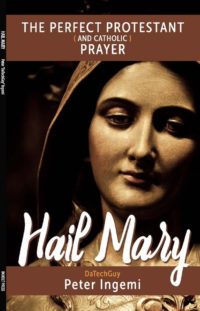
In his new book, Ingemi puts aside political reporting and takes up a labor of love: Hail Mary: the Perfect Protestant (and Catholic) Prayer [Imholt Press, 2017, 80 pages, $6.99 paperback, $2.99 Amazon Kindle e-book]. Ingemi is donating a portion of every sale to his local Catholic radio station in north central Massachusetts.

The book’s title is intriguing and perplexing at the same time. Ingemi is reaching for two audiences, and he’s likely to score with his fellow Catholics. Will the word “Protestant” in the title appeal to anyone? Among my own acquaintances are people who identify themselves as Baptist, Lutheran, or simply Christian – but Protestant, however accurate in a historical sense, is not a label they use. I wonder how many of Ingemi’s intended readers will get past his book’s title.

Book-cover-e1499903750923Those who do will find a brief (80 pages), straightforward examination and celebration of the Hail Mary prayer. Ingemi writes in the hope that all Christians, Catholic and non-Catholic alike, will come to value the prayer’s meaning.

Ingemi takes the reader through the Hail Mary clause by clause. In the early part of the prayer, the words are taken from Scripture, offering common ground for all of Ingemi’s intended readers.

The second part of the prayer, following the invocation of the name of Jesus, also gets a line-by-line breakdown that flows naturally from what has come before.

This book could be one resource for any Catholic’s personal education, because it illuminates a prayer so common to Catholics that it might be taken for granted. It also could equip Catholics to explain the Hail Mary to non-Catholic friends.

Ingemi’s enthusiasm is irreproachable. He is nevertheless frank about the fact that he has no credentials as a theologian. This is a personal labor of love, not a work of scholarship.

If there is ever a second edition, the book would benefit from tighter copyediting and a sharper focus on readers who profess faith in Christ yet don’t understand Catholicism or Marian prayer. The author assumes knowledge of some things which have yet to be proven or explained to non-Catholic readers.

As for his Catholic readers, they’d probably be pleased to see a future edition carry an imprimatur. I know from conversation with the author that he’d be pleased for his work to receive one.

At its best, Ingemi’s book reflects faith that is informed by hope and charity, not by fear. Peter Ingemi sees the Hail Mary as a unifier for Christians. He will make a reasonable case for that to anyone, whether Catholic or not, who approaches his book with curiosity and good will.

Note: I received and reviewed a courtesy copy of the book’s text in proof form. Some typos and grammar detracted from the book’s quality, but they may have been corrected in the final published version. 

This post is part of the #OpenBook linkup hosted at My Scribbler’s Heart and CatholicMom.com.