A small step, right direction: less tax money to UNFPA

President Trump’s State Department has told the United Nations Population Fund (UNFPA) to get along without U.S. financial support. There are people who think this is a bad idea. I’m not one of them. Neither is Reggie Littlejohn.
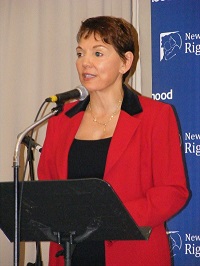
DSCF9824
Reggie Littlejohn of Women’s Rights Without Frontiers (Ellen Kolb photo)

I met Reggie very briefly a couple of years ago, when we were speakers at a pro-life convention in New Hampshire. My job was to talk about effective use of social media. Reggie’s job was to talk about China’s coercive abortion policy. She got better billing – and deserved it. Her stories were compelling and persuasive.

She became interested in Chinese policy when as an attorney she represented a Chinese woman seeking political asylum in the United States. It was Reggie’s first exposure to the wretched effects of the One-Child Policy: forced abortion, forced sterilization, and gender imbalance as boys are more valued culturally than girls. The revelations changed her life. She later established Women’s Rights Without Frontiers, an international coalition dedicated to fighting forced abortion in China.

Wherever she speaks, she points out the support China’s policies have received from UNFPA. She has called repeatedly for U.S. de-funding of the organization. She released a statement the other day when de-funding was finally announced.

“We are thrilled that the U.S. is no longer funding forced abortion and involuntary sterilization in China.  The blood of Chinese women and babies will no longer be on our hands. My very first press release, in 2009, was entitled ‘You Are Funding Forced Abortions in China.‘ I have consistently advocated for the defunding of UNFPA over the years…

“The UNFPA clearly supports China’s population control program, which they know is coercive. Under China’s One (now Two) Child Policy, women have been forcibly aborted up to the ninth month of pregnancy. Some of these forced abortions have been so violent that the women themselves have died, along with their full term babies. There have been brutal forced sterilizations as well, butchering women and leaving them disabled. Where was the outcry from the UNFPA? In my opinion, silence in the face of such atrocities is complicity….The UNFPA’s silence in the face of decades of forced abortion has been a sword in the wombs of millions of women and babies of China. I rejoice with them that the foot of the UNFPA is finally off of their necks.”

I remember listening to Reggie speak around the time China shifted to a Two-Child Policy. She was unimpressed by the change. “What matters is they’re telling people how many kids to have and they’re enforcing it with forced abortions.” She elaborated on that in a 2015 press statement about the policy shift.

“A two-child policy will not end any of the human rights abuses caused by the One Child Policy, including forced abortion, involuntary sterilization or the sex-selective abortion of baby girls….Noticeably absent from the Chinese Communist party’s announcement is any mention of human rights. The Chinese Communist Party has not suddenly developed a conscience or grown a heart. Even though it will now allow all couples to have a second child, China has not promised to end forced abortion, forced sterilization, or forced contraception.

“…In a world laden with compassion fatigue, people are relieved to cross China’s one-child policy off of their list of things to worry about. But we cannot do that. Let us not abandon the women of China, who continue to face forced abortion, and the baby girls of China, who continue to face sex-selective abortion and abandonment. The one-child policy does not need to be modified. It needs to be abolished.”

Let’s hear UNFPA speak up for Chinese women that way. Until then, the agency can get along without U.S. taxpayer support.


Cross posted at DaTechGuy Blog.

Open Book: “Gosnell”

The first Wednesday of each month brings Open Book, a blog linkup co-hosted by My Scribbler’s Heart and CatholicMom.com with a roundup of what participating bloggers have been reading lately.

Gosnell by Ann McElhinney and Phelim McAleer is not easy to read. The style is smooth and fluent, but the topic’s a tough one: Kermit Gosnell, former abortion doctor, now serving life in prison. He killed children who survived attempts to abort them. He was found responsible for the death of a woman who came to him for an abortion and died under what passed for his “care.”

He committed terrible crimes. He is in prison now. Reporters covered the trial as it happened, once they were shamed into it by people like journalist Kirsten Powers. Three years after Gosnell’s conviction, there is now a book that sets down not only what happened, but tells more about the people who were involved. As McElhinney and McAleer tell their stories, the book becomes less about a court case and more about human beings, capable of good choices and bad ones.

I listened to McIlhinney and McAleer talk about their book at CPAC, a political conference in Washington. An odd venue, but perhaps that was the place to reach readers who might not otherwise hear of the book. McAleer was a quiet man, leaving most of the talking to his co-author (who is also his wife).

McIlhenney was not at all quiet. She was passionate and angry as she talked about Gosnell. She was indignant. She called Gosnell “America’s biggest serial killer,” and she meant it. She made no bones about it: she had no objectivity left regarding her subject.

Familiar as I was with the Gosnell case, and as impressed as I was by McElhinney’s passion, I wondered what could be new in the book. As I read, I quickly realized that the close attention to the individuals involved in the case, starting with the investigators, set Gosnell apart from anything else I’ve read on the subject.

The authors’ perspective is unique as well, as McElhinney explains in the preface: “I never trusted or liked pro-life activists. Even at college I thought them too earnest and too religious.”

Fast forward to April 2013 and Kermit Gosnell’s trial in Philadelphia, when everything changed….[T]he images shown in the courtroom were not from activists, they were from police detectives and medical examiners and workers at the 3801 Lancaster Ave. clinic….What they said and the pictures they showed changed me. I am not the same person I was.

The “objective” book about Kermit Gosnell has yet to be written. For now, from that angle, the grand jury report about him will suffice. Why take time for a book-length account of such a sad and painful story, told with a definite point of view?

To meet people like Detective Jim Wood, who was part of the team investigating Gosnell for prescription drug offenses long before the abortion story was uncovered, and to meet Christine Wechsler and Joanne Pescatore from the D.A.’s office. They and many others described in the book were good people who did hard jobs well.

Semika Shaw and Karnamaya Mongar and their families get respectful attention from the authors, much more so than they did from authorities at the times of their deaths at Gosnell’s clinic. Those women are worth reading about.

The authors interviewed Kermit Gosnell in his Pennsylvania prison, dedicating a chapter of the book to the surreal, disturbing encounter. Gosnell’s calmly repeated assertions that he has done nothing wrong boggle the mind after three hundred pages of documentation to the contrary. The book would have been incomplete without the interview. Many people, including the authors, were changed by the Gosnell case; what of Gosnell himself? He hasn’t changed a bit, as the interview makes clear. “I very strongly believe myself to be innocent of the heinous crimes of which I am accused.”

That’s an update, not closure. Closure might not be possible in the wake of the butchery at Gosnell’s clinic. There may yet be some good outcomes, meaning fewer deaths and injuries, if states move ahead with the kind of abortion-facility regulations recommended by the Gosnell grand jury. The authors of Gosnell urge action, not promises.

McElhinney and McAleer are working on a Gosnell film, which they screened at CPAC to an audience that should have been larger. It’s a drama, not a documentary, still in post-production. It looks good, and it will deserve a wide audience. Anyone who reads Gosnell will want to see the film, and anyone who sees the film is going to want to find the book.

For some people, the hard part of picking up the book will be the aversion prompted by the very name Gosnell. The authors share the aversion, but they have nonetheless written a clear and diligently-researched book. They introduce the reader to people worth knowing. McElhinney and McAleer have a sharp eye for medical and legal matters, and a deep concern for justice and human dignity.

The people this book was really written for, though, are the people who aren’t moved by Gosnell’s name or crimes or trial. In Gosnell, Ann McElhinney and Phelim McAleer are pleading: wake up.  From every page, they reach out to shake the reader out of indifference. As McElhinney writes,

I am absolutely certain that the dead babies spoken of in court were unique people whom the world will now never know. I hope this book and the movie go some way to mark the fact that they lived and in their short lives made a difference. Time will tell. This story can change hearts and minds; it has mine.