President Trump’s State Department has told the United Nations Population Fund (UNFPA) to get along without U.S. financial support. There are people who think this is a bad idea. I’m not one of them. Neither is Reggie Littlejohn.
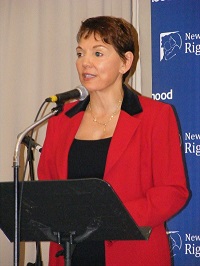
I met Reggie very briefly a couple of years ago, when we were speakers at a pro-life convention in New Hampshire. My job was to talk about effective use of social media. Reggie’s job was to talk about China’s coercive abortion policy. She got better billing – and deserved it. Her stories were compelling and persuasive.
She became interested in Chinese policy when as an attorney she represented a Chinese woman seeking political asylum in the United States. It was Reggie’s first exposure to the wretched effects of the One-Child Policy: forced abortion, forced sterilization, and gender imbalance as boys are more valued culturally than girls. The revelations changed her life. She later established Women’s Rights Without Frontiers, an international coalition dedicated to fighting forced abortion in China.
Wherever she speaks, she points out the support China’s policies have received from UNFPA. She has called repeatedly for U.S. de-funding of the organization. She released a statement the other day when de-funding was finally announced.
“We are thrilled that the U.S. is no longer funding forced abortion and involuntary sterilization in China. The blood of Chinese women and babies will no longer be on our hands. My very first press release, in 2009, was entitled ‘You Are Funding Forced Abortions in China.‘ I have consistently advocated for the defunding of UNFPA over the years…
“The UNFPA clearly supports China’s population control program, which they know is coercive. Under China’s One (now Two) Child Policy, women have been forcibly aborted up to the ninth month of pregnancy. Some of these forced abortions have been so violent that the women themselves have died, along with their full term babies. There have been brutal forced sterilizations as well, butchering women and leaving them disabled. Where was the outcry from the UNFPA? In my opinion, silence in the face of such atrocities is complicity….The UNFPA’s silence in the face of decades of forced abortion has been a sword in the wombs of millions of women and babies of China. I rejoice with them that the foot of the UNFPA is finally off of their necks.”
I remember listening to Reggie speak around the time China shifted to a Two-Child Policy. She was unimpressed by the change. “What matters is they’re telling people how many kids to have and they’re enforcing it with forced abortions.” She elaborated on that in a 2015 press statement about the policy shift.
“A two-child policy will not end any of the human rights abuses caused by the One Child Policy, including forced abortion, involuntary sterilization or the sex-selective abortion of baby girls….Noticeably absent from the Chinese Communist party’s announcement is any mention of human rights. The Chinese Communist Party has not suddenly developed a conscience or grown a heart. Even though it will now allow all couples to have a second child, China has not promised to end forced abortion, forced sterilization, or forced contraception.
“…In a world laden with compassion fatigue, people are relieved to cross China’s one-child policy off of their list of things to worry about. But we cannot do that. Let us not abandon the women of China, who continue to face forced abortion, and the baby girls of China, who continue to face sex-selective abortion and abandonment. The one-child policy does not need to be modified. It needs to be abolished.”
Let’s hear UNFPA speak up for Chinese women that way. Until then, the agency can get along without U.S. taxpayer support.