Listen to “Hush”

A few months ago, I saw an advance screening of a documentary from what seemed to me an unlikely team. The “Hush” film’s producer and director take different views of abortion. They set out not to assert one side or another. Instead, they made a film about abortion’s effect on women’s health. The director was still pro-choice when she finished making the film, but she was troubled by her findings.

“Start a healthy conversation,” as the production team says in the film’s Twitter hashtag. A good goal, and an urgent one.

“Hush” went into formal release a couple of months ago. A library near my home is hosting a screening next week. A friend reported to me tonight that she’s getting online pushback for promoting the film, from people who dispute the film’s findings – without having seen the film.

Frustrating. Dismaying. Yet I hold out hope that the protesters will come to the screening. They might be surprised to discover that “Hush” isn’t a pro-life movie per se. It’s one woman’s search for answers to her legitimate questions about what, if anything, abortion does to women besides induce the death of a preborn child (a term with which the director might well take issue).

I’m grateful to the documentary’s director, Punam Kumar Gill, for asking questions and having the courage to follow the answers wherever they took her.

I hope the protesters in my area choose to come inside and watch the film. Let the pushback wait until we’re all working with the same information. Better yet, let’s work toward that healthy conversation the filmmakers are encouraging.

Read more about “Hush” and where to find it at hushfilm.com.

photo10-215x215        photo-1-215x215

Open Book: Betty Smith and Rumer Godden

The first Wednesday of each month brings #OpenBook, a blog linkup co-hosted by My Scribbler’s Heart and CatholicMom.com with a roundup of what participating bloggers have been reading lately.

I’ve been re-reading two old favorites from my fiction shelves. It’s pure coincidence that my first #OpenBook entry happens to include two books mentioned by other bloggers last month: A Tree Grows in Brooklyn by Betty Smith and In This House of Brede by Rumer Godden.

The first time I encountered A Tree Grows in Brooklyn was about 40 years ago in a Reader’s Digest condensed version for kids (“Best-Loved Books”). “Condensed” makes it sound about as appealing as canned soup, but Smith’s Francie Nolan came to life for me and sent me hurrying to the library for the full novel in its unedited glory. A book about a child, yet not a children’s story, it has drawn me into Francie’s Brooklyn of 1912 over and over again.

Each time I re-read this book, I’m struck anew at how such a rich, moving story is conveyed in thoroughly unsentimental prose. Fair warning: at whatever age you pick up the book, the characters and what their creator calls their thin invisible steel will not let you walk away easily.

And then there’s Brede, Rumer Godden’s story about a Benedictine monastery and the delayed religious vocation of a forty-something woman. Reading it now, I see texture and depth that I missed when I first picked up the book as a teenager. And for heaven’s sake, if you come across the TV movie made from the book ages ago, turn it off and pick up the book.

Where my recent fiction reading has brought me back to familiar ground, I’m discovering a lot of nonfiction that’s new to me. After reading Edmund Morris’s The Rise of Theodore Roosevelt a few months ago, I’m now well into Theodore RexThe second book can stand on its own, but it’s best appreciated after reading the first volume. Next stop will be volume 3, covering Roosevelt’s post-Presidential years.

I’ve read plenty by C.S. Lewis and a little by G.K. Chesterton, but this is the first time I’ve opened Mere Christianity and The Everlasting Man. I’m feeding my inner poli sci grad with Rebecca West’s The Meaning of Treason and John Stuart Mill’s On Liberty. With the possible exception of Mere Christianity (much of which is based on a series of radio broadcasts), none of these lends itself to reading-by-nibbles. Giving these books the time they deserve means cutting back on screen time, except of course with my trusty Kindle – and the fact that I find that a bit wearing startles me.

The risk of being more like Mother Teresa

IMG_20160121_202730

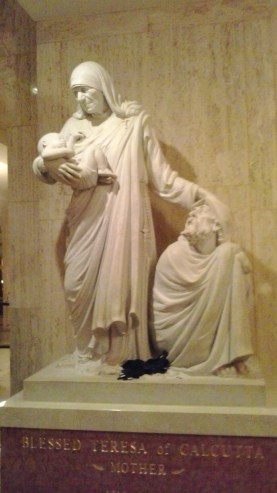
I saw the statue of Mother Teresa during a visit to the National Shrine of the Immaculate Conception in Washington, D.C. earlier this year. A pleasing and apt tribute, but a little unsatisfying, and it took me a minute to figure out why: the image is fixed and still, while its subject was always moving. Not mere motion, either, but positive and focused action.

I’m glad Mother Teresa is being canonized this weekend. I’ve thought of her for along time as a saint. With or without miracles, she embodied heroic virtue and service. How much of that will be understood by the people who weren’t around or weren’t paying attention when she was working in India?

She deserves more than to be reduced to a dry paragraph in a book of saints.

We can read about her. Start with Muggeridge’s Something Beautiful for God (a project that changed Muggeridge’s life). We can watch the movies  made about her life; I enjoyed The Letters. Eventually, though, I must move from hearing about her to hearing her.

Would you throw away an established career in midlife, to your own bewilderment and that of your superiors? She did, going from being a teacher as a Sister of Loreto to becoming a minister to the poor and foundress of an new religious order. “I was to leave the convent and help the poor while living among them. It was an order. To fail would have been to break the faith.” She called it her “call within a call.”

That woman had some nerve. Her address at the 1994 National Prayer Breakfast was but one illustration of her ability to unsettle world leaders. She talked about caring for the dying, about abortion, about natural family planning, about the urgency of first caring for one’s own family. Poor President and Mrs. Clinton found themselves seated while everyone else in the room was giving Mother Teresa a standing ovation.

I honestly don’t think she got up every morning thinking of how many people she could annoy. She simply went about her work and then told people about what she saw and did and believed. She served God with her words as much as with her deeds.

There was a bit of a fuss after her death when letters between her and her spiritual advisor became public. I remember some of the news coverage: Mother Teresa had doubts; she felt separated from God at times – as if those revelations somehow undermined her work and her reputation.That’s not how I took them, then or now.

She was really human. That was comforting in a way, but also unnerving. If this thoroughly human woman could do what she did even in the midst of internal turmoil, what’s my excuse?

I have none, of course.

It’s easy to say that I wish there were more people like her. It’s tougher to say that I want to be more like her. No telling where that could lead.