My thanks to Fr. Robert McTeigue, S.J., who welcomed me to “The Catholic Current” on The Station Of the Cross Catholic Radio Network. New Hampshire’s assisted suicide bill was the launching point for an hour of good conversation about public policy and the right to life.
The Catholic Current with Fr. Robert McTeigue: Ellen Kolb on physician-assisted suicide legislation in New Hampshire
Nothing scripted there: no prepared answers, since I didn’t know what the questions would be. His query about advice I might have to offer set me off on something that may have sounded a bit rehearsed, but wasn’t. Mass and Adoration. That’s my advice, and I didn’t just say that because it was Ash Wednesday. I talked about my reasons for that answer in the last part of the podcast.
All Souls’ Day: the one I don’t have to go to Church for, as opposed to All Saints’ Day. I’ve never quite shaken that childhood view. I take more note of the day than I did as a child; that comes with time and age and enduring the deaths of friends and loved ones.
I find myself saying brief silent prayers when I pass a cemetery. There’s no superstition or fear involved. It’s commending souls to God – I once thought that an odd phrase, but no longer. I even do it when the burial ground reveals no names.
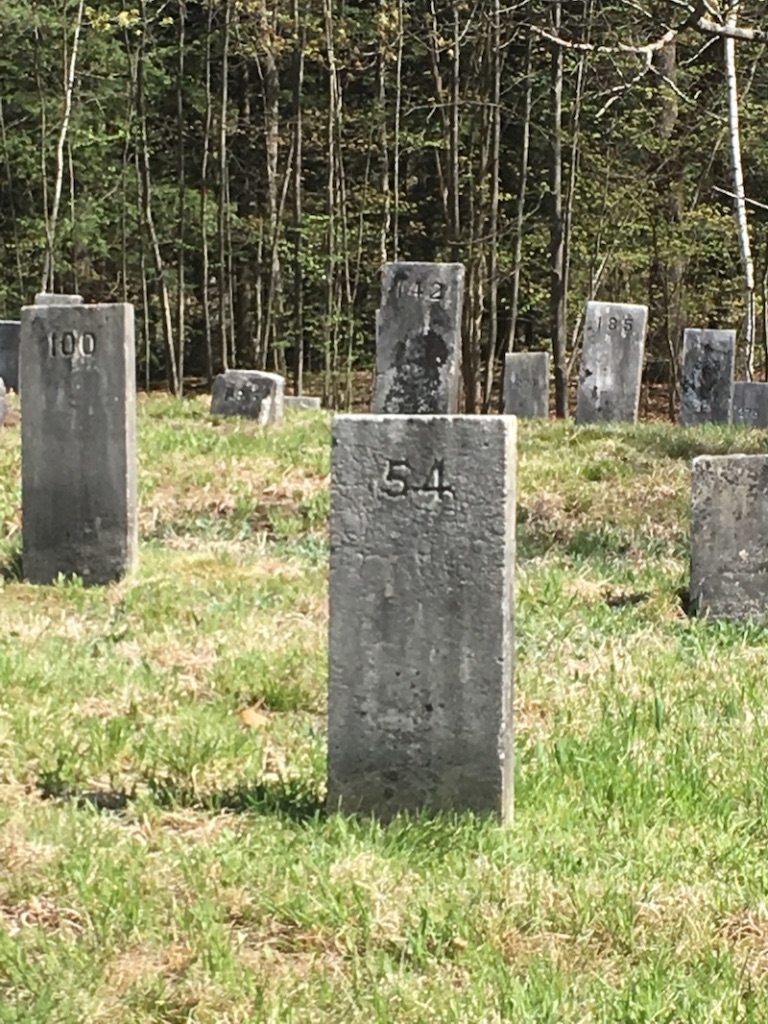
Hillsborough County Cemetery, Goffstown NH. Photo by Ellen Kolb.
There’s a small cemetery in a mildly improbable place along a rail trail near my house. It’s behind the county office complex, on the other side of what used to be a rail line. The other side of the tracks, literally, kept from view of the nearby busy road by the office buildings.
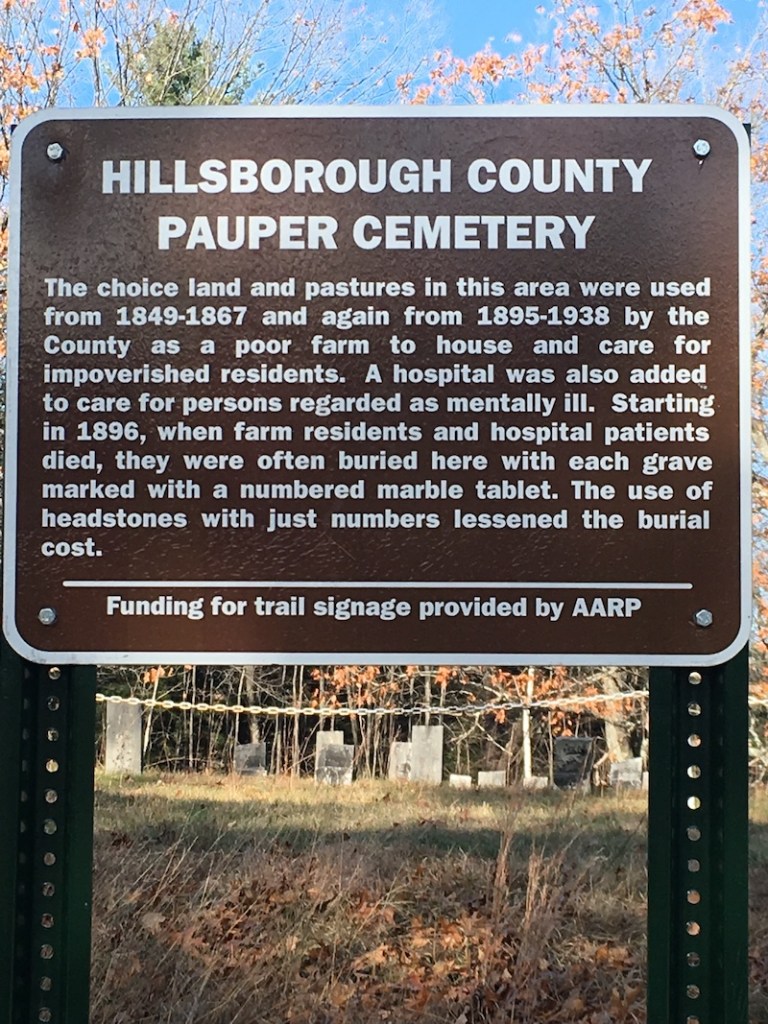
It’s a tidy place. There are weathered markers with numbers but no names. The grass around the markers is mown, but there’s no landscaping. There’s a flagpole. There’s a not-very-informative plaque, placed in 2001, obviously long after the cemetery was established. A newer sign, erected by trail supporters with a donation from AARP, gives a little more history.
Informational sign about old county cemetery, Goffstown NH
The cemetery’s location is a clue to its history: on county land, near county offices, near where a prison used to be. A friend with some knowledge of local history, plus a bit of online searching, told me a little more about it.
Everyone buried there was a county ward of some sort: a prisoner, a nursing home resident, an indigent person. The cemetery being small, markers had to be small as well, without expensive carving. The markers were simply numbered, and a ledger maintained in the county offices noted the names of each deceased next to the number of the grave.
One ledger, no backup. It was lost or destroyed, perhaps in a fire. The names were lost.
Each person had a name, a family, a story. Now, God only knows who they were. They have no one to pray for them, except the odd passer-by like me.
While rambling on New Hampshire trails, I’ve come across old family cemeteries with stones lovingly inscribed with names, dates, and images. There might be nothing left of a homestead but a cellar hole, but the family graveyard was made to last, and the names were meant to be remembered.
There was no such heritage for county wards. So spare them a thought and an All Souls’ prayer. Add a little prayer of thanksgiving for the county worker who keeps their resting place tidy. It’s a kind of respectful mercy, and there’s grace in that.
I suspect Dorothy Day would have winced at the word “legendary” in the subtitle assigned to her memoir: the autobiography of the legendary Catholic social activist. Humility informs every page of The Long Loneliness. So does clear and inviting prose, a testament to Day’s experience as a journalist. She was a 20th-century treasure.
Up until now, Dorothy Day has been to me the subject of magazine articles and other people’s blog posts, some quite critical (not that criticism was likely to deter her). Picking up Day’s 1952 memoir was a revelation to me.
Dorothy Day, 1952. Credit: Unknown monks–no copyright as Subiaco Abbey notes on website link, CC0, via Wikimedia Commons
She wrote The Long Loneliness in middle age, when she was already known for her commitment to nonviolence and service to the homeless. (She had decades of activism ahead of her.) Known now as a “Servant of God” – an honorific for a Catholic whose cause for sainthood is under consideration – she was a convert, a decision that cost her dearly even as she embraced it with joy. She was determined to put her love of God into practice, whatever the cost.
She didn’t give lip service to “social justice.” She lived it, in soup kitchens – “houses of hospitality” – that she helped to establish and in the advocacy she gave to anyone who was disadvantaged. She didn’t romanticize the work; anyone coming to help was expected to take a practical view of things. Yet workers and volunteers came anyway, building a community grounded in faith and service that came to be known as the Catholic Worker movement. Day called community of that sort the key to dealing with “the long loneliness.”
Not everything she did met with approval from authorities. The memoir includes a brief account of the moral and practical challenges faced by pacifists like her as the United States formally entered World War II. Her explanation of her actions has no trace of self-righteousness. Instead, as throughout the book, her words are full of warmth and compassion even when they are blunt and forthright.
The memoir is rich with Day’s descriptions of the people she met along her way. None was more influential to her spiritual and social growth than Peter Maurin. She generously considered him the founder of the Catholic Worker movement, leaving the reader to reflect on how the movement might have foundered without Day’s particular gifts as writer and organizer.
Day was an interesting woman who lived in interesting times, and she wrote with a keen pen. That alone makes The Long Loneliness worth reading. A better reason, and one Day would likely deem more important, is her story of conversion to the Catholic faith and the vocation she followed thereafter.
There are multiple editions of The Long Loneliness. Look for one unburdened with explanatory material. Let Day speak for herself.


.jpg)
 Ellen Kolb