Life-issue public policy: a means, not an end

Worth remembering as an election looms and my mailbox overflows and the ads reach saturation points: “policy” is a means, not an end. The former lobbyist in me needs the reminder occasionally.

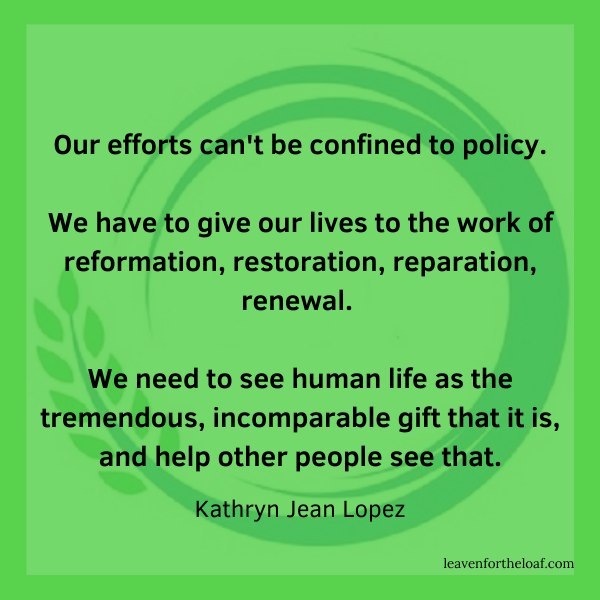
Journalist Kathryn Jean Lopez always provides edifying reading, and she has often made the point that getting a bill passed is not the same as building a culture of life. She summarized it best in these words: “Our efforts can’t be confined to policy. We have to give our lives to the work of reformation, restoration, reparation, renewal. We need to see human life as the tremendous, incomparable gift that it is, and help other people see that.”

I’ll keep telling people to get to the polls. And still, I can see that our most lasting work will be accomplished during the other 364 days in the year.

Remembering a defender of life

The celebration of All Saints and observance of All Souls are just ahead. Among those whom I’ll be remembering in prayer is an acquaintance, a Catholic pro-life journalist named Jack Kenny, who passed away a few weeks ago. I invite you to remember him in prayer as well. I wrote a memorial post over at Leaven for the Loaf. I’d like to share a few excerpts here.


Jack Kenny has succumbed to cancer. He was a Manchester, New Hampshire journalist with broad interests, astringent opinions, and an abiding devotion to the most vulnerable human beings among us.

Jack Kenny. Image from https://obits.phaneuf.net/john-kenny

“…the right to life is, if you’ll pardon the expression, a hell of a subject for neutrality.” (Kenny, New Hampshire Union Leader, 9/13/98)

He once wrote about a Labor Day breakfast at which then-Governor Jeanne Shaheen was featured speaker. A Catholic priest was honored at the event for his work promoting social justice. Jack raised an eyebrow. “If you think this is ‘single-issue’ fanaticism, ask yourself this: Would [the monsignor] share a platform with someone who advocated racial discrimination or espoused anti-Semitism?…Yet Gov. Shaheen supports, promotes and defends as a ‘right’ the killing of preborn babies. No problem. Organized labor doesn’t care and the monsignor pretends not to notice.”

Back in the 1990s, “Optima Health” was big news. It was an attempt to link Manchester’s Catholic Medical Center with Elliot Hospital. One of the rocks on which that venture foundered was the revelation of a scheduled abortion at the Elliot, contravening assurances that such things wouldn’t happen under Optima. It was a complex and lengthy story. While all this was going on, Jack wrote about the people who risked jail and loss of livelihood to raise alarms about the danger Optima posed to CMC’s Catholic identity.

I recall another late-’90s incident that would have been a one-day story if Jack hadn’t helped to keep it out in the open. Pro-lifers were demonstrating peacefully one evening outside a fundraising event for an abortion advocacy group; the Portsmouth police got involved; arrests and a broken wrist ensued. Jack whipped out his pencil and started asking questions of the relevant parties.

“The right to peacefully assemble and protest belongs as much to those protesting abortion as anyone else. Or at least it used to. It can hardly be surprising if a society that no longer respects the right to life becomes indifferent to other rights as well.”

Politics might have been a passion, but Jack knew that his Creator transcended such matters.

A few years ago, the long-shuttered St. Stanislaus Catholic Church in Nashua was revived as a parish where the Latin Mass could be celebrated daily. At the very first Mass there, the place was packed with worshippers. There were old-timers from the days when St. Stan’s had been the ethnic parish in the neighborhood. There were people like me who were curious about the Latin Mass. And then there were the people already familiar with the traditional rite, praying with joy, very much at home. Jack was one of those people.

I hardly recognized him when he sat down near me. I had never seen his face in such repose. He had left his political indignation outside the door in order to put himself at the foot of the Cross.

I trust that in God’s mercy, Jack is now surrounded by the innocent souls he defended so ardently. May his repose be complete.


Emerging: Covid gets personal

Above my desk is a shelf full of go-to books, selected from the thousand or so volumes scattered throughout my house. That shelf holds my essentials: prayer books, spiritual commentaries, lives of the saints, and my current favorites among life-issue books (think Gosnell). I can pick up any of them and come across something about challenges and sufferings and how they are part of the Christian pilgrimage on earth.

Academic stuff, that. No emotional impact. I have been blessed with good health all my life. Not having it is something that happens to Other People. Flannery O’Connor’s MS, St. Faustina’s tuberculosis, the lifelong disabilities endured by New Hampshire author Christina Chase: how admirable to put one’s sufferings at the foot of the Cross as they did.

I now feel like a patronizing fool.

Covid hit me a few months ago, as it has hit nearly everyone I know. A few lousy days and it was over, or so I thought. I waited for the fatigue and loss of strength to ease. I waited for my cognitive skills to get back up to speed; for awhile I couldn’t read or write for more than a few minutes at a time. I kept waiting. I kept needing extra help and physical support. After a few weeks it dawned on me: this is what post-Covid syndrome feels like.

Put it at the foot of the Cross? Only if you count my constant prayer to God to take that particular cup from me. After months, the cup is being withdrawn. I have the uneasy feeling that I didn’t handle this well. I know now that health is a gift rather than an entitlement – I’m one illness or injury away from being right back to helplessness – and I ponder how I’ll do next time. Sure, I’ll offer up whatever burdens come my way. But right in there will be a plea that I’ll no longer have burdens to bear.

That’s humbling. Those books on my shelf seem to reproach me silently. I must say that I wish some of the authors would come visit me; I think we could laugh and commiserate and praise God and encourage each other. They’d give me good-natured teasing for thinking that I’m somehow different from the rest of humanity. (After all, I eat my vegetables, usually; I get my checkups; I exercise; surely I shouldn’t get sick.)

My energy and stamina are returning, gradually. I’m re-emerging. Improvement is by fits and starts, but it’s trending in the right direction. I know that many people suffering post-Covid problems aren’t so lucky. I’m being blessed with recovery. If there’s a limit to it, at least I’m functioning. My gratitude knows no bounds.

And at the same time, I have the uneasy feeling – more than that; the certain knowledge – that the time of illness was a kind of blessing as well. A divine invitation, if you will, to explore places known to God that I had never imagined. I didn’t recognize that invitation, I wasn’t ready for it, and I fought it every step of the way.

Gratitude fills my days. So does humility. The divine invitation might be repeated. I truly don’t know how I’ll respond.


A milestone in my emergence from post-Covid problems was a recent walk, a short one, up a mountain not too far away. I’ve seldom rejoiced so much in such a modest hike. I wrote about it at Granite State Walker, with a couple of photos from the summit.